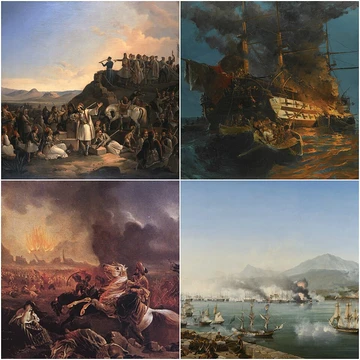
Usman dan Fodio
Fulani scholar who founded the Sokoto Caliphate.

Abdulmuddalib Iabrahim Salisu · CC BY-SA 4.0
He founded the Sokoto Caliphate and ruled as its first caliph. Born in Gobir, he became well educated in Islamic studies and began preaching Sunni Islam throughout territories that later became parts of independent Nigeria and Cameroon. He wrote more than a hundred books concerning religion, government, culture, and society, and developed a critique of existing African Muslim elites for what he saw as their greed, paganism, and violation of Sharia standards.
- field
- Islamic scholarship, religious teaching, poetry, philosophy, revolution
- nationality
- Fulani, from the Hausa Kingdoms
- known_for
- Founding the Sokoto Caliphate and leading an Islamic religious and social revolution
Lore & Background
Usman dan Fodio was born in Gobir, a descendant of the Oudah clans Fulani people living in the Hausa Kingdoms since the early 1400s. His ancestors were Toronkawa who migrated from Futa Tooro in the 1300s. His mother Hauwa is believed to be a direct descendant of Muhammad through Maulay Idris I. Usman studied the Quran with his father and later with other teachers including Jibril bin Umar, a proponent of jihad. At age 20, he set up his school in Degel, where he preached and studied, becoming well educated in classical Islamic science, philosophy, and theology.
Reader's Guide
Usman dan Fodio formed an Islamic religious and social revolution that spread from Gobir throughout modern Nigeria and Cameroon, influencing other rebellions across West Africa and beyond. He declared jihad against the Hausa land and defeated them, expanding the caliphate into present-day Burkina Faso, Cameroon, Southern Niger, and most of Northern Nigeria. He declined much of the pomp of rulership and passed actual leadership to his son, Muhammed Bello. He encouraged literacy and scholarship for women as well as men, and several of his daughters emerged as scholars and writers. His writings and sayings continue to be quoted today, and some followers consider him a mujaddid, a divinely sent reformer of Islam. His uprising was a major episode of a movement described as the jihad in the 17th, 18th, and 19th centuries, following earlier jihads in Futa Bundu, Futa Tooro, and Fouta Djallon. He inspired later West African jihads, including those of Seku Amadu and Omar Saidou Tall.
Did You Know?
- Usman dan Fodio wrote more than a hundred books concerning religion, government, culture, and society.
- He encouraged literacy and scholarship for women as well as men, and several of his daughters emerged as scholars and writers.
- His mother Hauwa is believed to be a direct descendant of the Islamic prophet Muhammad through Maulay Idris I.
The Fractured World of Eighteenth-Century Hausaland
By the mid-eighteenth century, the once-dominant Kanem-Bornu Empire was in visible decline, and the political landscape of the region was shifting dramatically. Waves of Fulani pastoralists had migrated into the area, creating friction with the more sedentary Hausa communities even though both groups shared the Islamic faith. Former tributaries of Kanem-Bornu had broken free and turned on one another in a cycle of conflict. The rulers of the emerging Hausa kingdoms imposed heavy conscription and taxation, while the constant warfare produced social upheaval, economic suffering, and the enslavement of captives. Fulani communities, in particular, felt targeted by Hausa authorities' control over land and tax collection. Two kingdoms—Gobir, where Usman dan Fodio spent his formative years, and Zamfara—would sit at the center of the coming upheaval. This volatile mix of religious tension, economic grievance, and political fragmentation set the stage for a conflict that would reshape the entire region.
From Preacher to Exile
By the 1790s his reputation had grown considerably. His sermons centered on what he saw as the moral duties of Muslim rulers: to uphold Islamic principles, govern with generosity and fairness, and protect their subjects' ability to practice their faith. He spoke sharply against corruption, hypocrisy, and the oppression of fellow believers, and he condemned the tolerance of practices he considered incompatible with Islam. At first, the leadership of Gobir supported his preaching. But as his following swelled and he began urging his followers to arm themselves for self-defense, the political winds shifted. King Nafata of Gobir imposed a series of restrictions on dan Fodio and his adherents. The rupture between teacher and former pupil had become irreparable.
The Hijra and the War of Liberation
Enraged, dan Fodio's supporters attacked the royal army and freed the captives. Yunfa offered dan Fodio a choice: leave Degel before the village was destroyed, or face annihilation. Rather than abandon his community, dan Fodio led a mass migration—what is known as a hijra—toward Gudu. His followers responded by proclaiming him the Amir al-Mu'minin, the Commander of the Faithful, and severing their loyalty to Gobir. The conflict that followed was not a single battle but a grinding campaign. Early skirmishes gave way to the Battle of Tsuntua, where Yunfa won a tactical victory but failed to break dan Fodio's force. Dan Fodio retaliated by seizing the village of Matankari, triggering the larger Battle of Tabkin Kwatto. Despite being outnumbered, his mixed army of Hausa, Fulani, and Tuareg fighters held the line, preventing Yunfa from advancing and drawing in yet more recruits.
Conquest, Caliphate, and a Ripple Across Africa
The momentum of the campaign proved decisive. The following year, 1808, saw the fall of Gobir itself and the execution of Yunfa, the king who had once been dan Fodio's student. From the ashes of the old Hausa kingdoms rose the Sokoto Caliphate, initially led by dan Fodio himself. It would grow to become one of the largest political entities on the African continent during the nineteenth century. The impact radiated far beyond its borders. In the Kanem-Bornu region, Fulani leaders such as Bi Abdur, Lerlima, and Ibrahim Zaki launched parallel campaigns against Bornu's authority, while in the Deya area, scholars al-Bukhari and Goni Mukhtar led their own resistance. Dan Fodio's success demonstrated that a scholar's moral authority could be converted into a vast political and military enterprise, inspiring similar jihads across Western Africa and reshaping the region's map for generations.
Gallery



Frequently Asked Questions
Who is Usman dan Fodio?
He was a Fulani-born Islamic scholar, poet, and philosopher from the Hausa Kingdoms who spearheaded a major religious and social revolution in West Africa. He is best remembered as the founder and first caliph of the Sokoto Caliphate.
What was Usman dan Fodio's role in the revolution?
He led an Islamic uprising against local Muslim elites he considered corrupt, and his movement culminated in the creation of the Sokoto Caliphate, which he then governed as its first caliph. His field of influence spanned Islamic scholarship, religious teaching, poetry, philosophy, and revolutionary organizing.
What did Usman dan Fodio write?
He produced more than one hundred works covering religion, government, culture, and society. His corpus also included poetry and philosophical treatises that laid the intellectual groundwork for his reform movement.
Why did Usman dan Fodio launch his revolution?
He believed the existing African Muslim ruling class had grown greedy, adopted pagan practices, and abandoned proper Sharia standards. His preaching of strict Sunni Islam across the territories of present-day Nigeria and Cameroon became the ideological engine of the uprising.
Why is Usman dan Fodio important to the history of revolution and independence?
He proved that a scholar's pointed critique of an entrenched elite could mobilize an entire population into a sustained revolutionary movement. The Sokoto Caliphate he established permanently reshaped the political map of modern Nigeria and Cameroon, making him a landmark figure in faith-driven independence revolutions.
More in Leaders Of Revolution And Independence 1-20
Spotted an error? Know more?
This is a living reference — every entry is fact-audited, and reader corrections feed straight into our audit queue. Suggest an edit · See this site's audit record