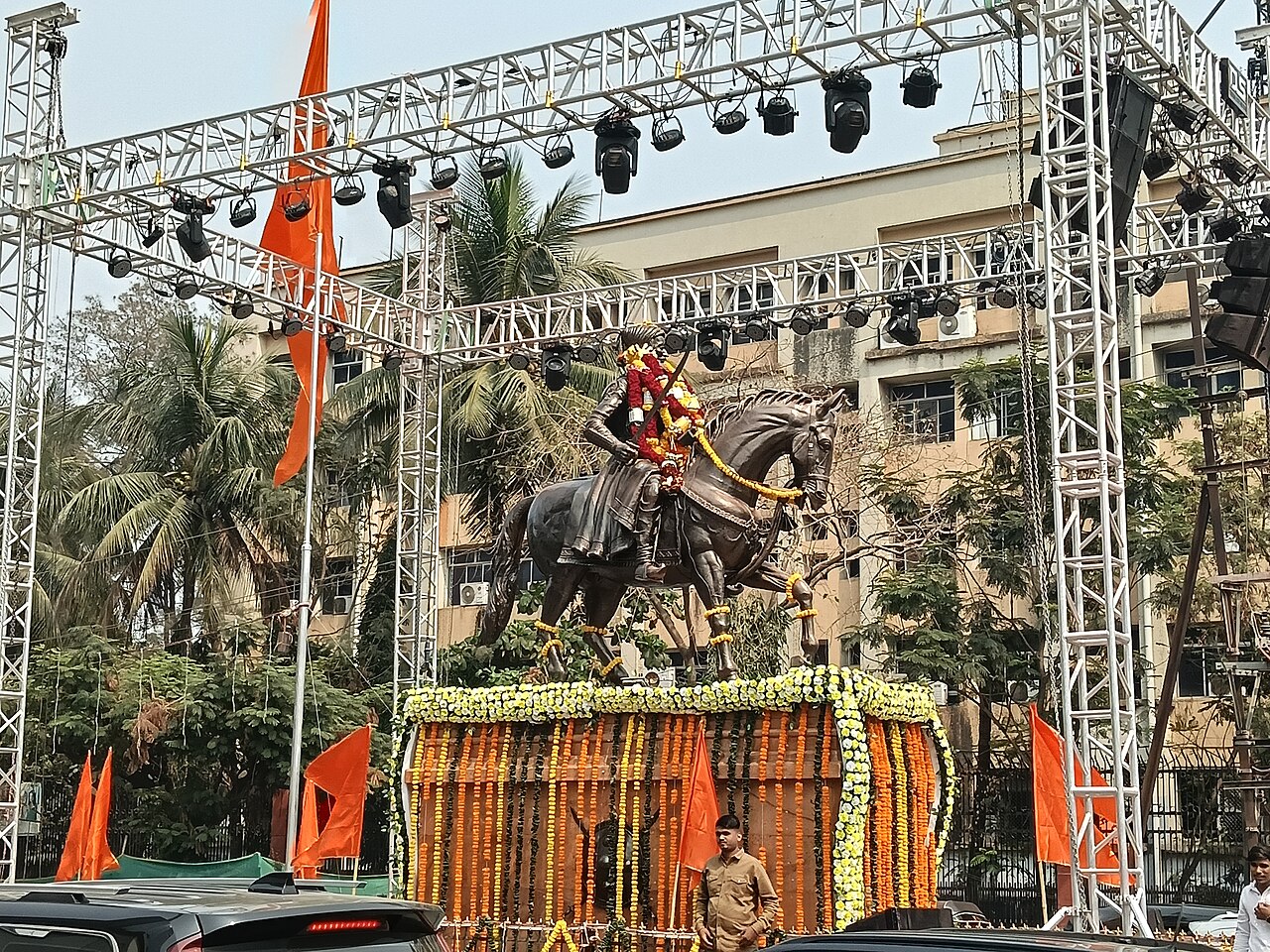
Shivaji
Indian ruler who founded the Maratha Kingdom.

Harvinder Chandigarh · CC BY-SA 4.0
Shivaji I (c. He inherited a fiefdom from his father, who served as a retainer for the Sultanate of Bijapur, which later formed the genesis of the Maratha Kingdom. Over his life, he engaged in alliances and hostilities with the Mughal Empire, the Sultanate of Golconda, the Sultanate of Bijapur, and European colonial powers, expanding the Maratha sphere of influence.
- field
- Ruler, military leader
- nationality
- Indian
Lore & Background
Shivaji was born in the hill-fort of Shivneri near Junnar, in present-day Pune district. Scholars disagree on his exact date of birth; the Government of Maharashtra lists 19 February as a holiday commemorating his birth. He was named after the god Shiva. His father, Shahaji Bhonsle, was a Maratha general who served the Deccan Sultanates, and his mother was Jijabai. At the time of his birth, power in the Deccan was shared by three Islamic sultanates—Bijapur, Ahmednagar, Golkonda—and the Mughal Empire. Shahaji often changed his loyalty among these powers but kept his jagir at Pune and his small army. Over the next two years, he took several important forts near Pune, including Purandar, Kondhana, and Chakan. He used the treasure to expand the captured fort of Rajgad, which served as his seat of government for over a decade. Later, after his defeat at the hands of Jai Singh I in the Battle of Purandar, Shivaji entered into vassalage with the Mughal empire in 1665, assuming the role of a Mughal chief. The title 'Raja' was formally conferred upon him by Aurangzeb in 1665; however, during his visit to Agra in 1666, he was insulted and not granted any additional honors, and he famously escaped from captivity.
Reader's Guide
Shivaji's significance lies in his role as the founder of the Maratha Kingdom, which emerged from a fiefdom inherited from his father. He employed people of all castes and religions, including Muslims and Europeans, in his administration and armed forces. His military forces expanded the Maratha sphere of influence, capturing and building forts, and forming a Maratha navy. His legacy was revived by Jyotirao Phule about two centuries after his death. Later, he came to be glorified by Indian nationalists such as Bal Gangadhar Tilak, and appropriated by Hindutva activists. His life illustrates the complex political landscape of 17th-century India, involving shifting alliances with the Mughal Empire, the Sultanate of Bijapur, and other powers.
Did You Know?
- Shivaji was named after the god Shiva.
- Shivaji employed people of all castes and religions, including Muslims and Europeans, in his administration and armed forces.
- His legacy was revived by Jyotirao Phule about two centuries after his death.
Origins in a Shifting Deccan
His family, the Bhonsle clan, was deeply embedded in the military politics of the Deccan. His grandfather Maloji had earned the epithet Raja as a general of the Ahmadnagar Sultanate and secured deshmukhi rights over Pune, Supe, Chakan, and Indapur, along with Shivneri itself as a family residence. His father Shahaji continued this pattern of service, shifting his allegiance among the Nizamshahi of Ahmadnagar, the Adilshahi of Bijapur, and the Mughals, yet always preserving his jagir at Pune and his small army. His mother Jijabai, daughter of a Mughal-aligned sardar claiming Yadava royal descent, is credited by scholar James Laine with instilling in young Shivaji the vision of a Hindu kingdom, a dream sharpened by her awareness of her own lineage and her view of her husband as a low-born collaborator. The political stage was set by three Islamic sultanates and the Mughal Empire sharing power across the Deccan.
From Torna to a Maratha State
At sixteen, Shivaji seized Torna Fort through a combination of stratagem and bribery, exploiting the disarray in the Bijapur court caused by Sultan Mohammed Adil Shah's illness. The substantial treasure he discovered there became the seed capital for constructing Rajgad, which would anchor his government for more than a decade. In the two years that followed, he captured Purandar, Kondhana, and Chakan, and brought the eastern Pune regions of Supa, Baramati, and Indapur under his direct authority before turning west to take Kalyan on the Konkan coast. Against rival Maratha families holding deshmukhi rights under Bijapur, he employed a mix of marital alliances, direct dealings with village-level chiefs to bypass the higher nobility, and outright force. Over time his forces expanded the Maratha sphere by capturing and building forts and by forming a navy.
The Mughal Gambit
Shivaji's relationship with the Mughal Empire was marked by a remarkable oscillation between cooperation and defiance. He offered Aurangzeb passage and his own military service for an invasion of the weakening Bijapur Sultanate. Yet once Aurangzeb departed northward over a succession dispute, Shivaji moved to conquer the very territories that Bijapur had ceded to the Mughals. His subsequent defeat by Jai Singh I at the Battle of Purandar forced him into a humiliating vassalage, accepting the role of a Mughal chief. During this period he penned a series of letters apologising to Aurangzeb for his earlier actions and even requested additional honours for his services. The emperor eventually conferred upon him the title of Raja, and Shivaji carried out brief military expeditions on the Mughal side. Yet this accommodation was temporary.
A Legacy Reclaimed and Reimagined
Shivaji's historical image has been continually reshaped by those who came after him. In more recent decades, Hindutva activists have appropriated his figure for their own political narratives. Yet the historical record presents a ruler whose administration deliberately crossed caste and religious boundaries: he employed Muslims and Europeans alongside Marathas in both his government and his armed forces. His coronation itself was contested by local Brahmins, underscoring that his authority rested on military and administrative merit rather than priestly sanction. Across his life he engaged in both alliances and open hostilities with the Mughal Empire, the Sultanates of Golconda and Bijapur, and European colonial powers, weaving a web of diplomacy and warfare that expanded the Maratha sphere of influence far beyond the Deccan plateau.
Gallery



Frequently Asked Questions
Who is Shivaji?
Shivaji was an Indian ruler and military leader widely recognized as the founder of the Maratha Kingdom. He is celebrated in popular culture as a revolutionary figure who built an independent state from modest beginnings.
How did Shivaji's story begin?
He inherited a small fiefdom from his father, who had served as a retainer under the Sultanate of Bijapur. That modest territorial base became the seed from which the Maratha Kingdom eventually grew.
Who were Shivaji's main rivals?
Over the course of his life he formed shifting alliances and waged hostilities against the Mughal Empire, the Sultanate of Golconda, the Sultanate of Bijapur, and European colonial powers. His conflicts spanned both Indian and foreign adversaries.
What is Shivaji's lasting legacy?
He expanded the Maratha sphere of influence into a major political force in the Indian subcontinent. His founding of the Maratha Kingdom remains his defining historical achievement.
Why do fans of revolutionary leaders revere Shivaji?
He is admired for transforming a small inherited territory into a sovereign kingdom while simultaneously resisting several dominant empires and colonial powers. His story embodies the arc of a leader who built independence against overwhelming odds.
More in Leaders Of Revolution And Independence 1-20
Spotted an error? Know more?
This is a living reference — every entry is fact-audited, and reader corrections feed straight into our audit queue. Suggest an edit · See this site's audit record